Keeping fit (between meals, snacks, and fika)

This is a great place to keep fit. Other than the heat between about 11 am and 3 pm, everything is conspiring to get you outdoors and moving. The ocean, the beach, the bathing attire, the unemployment – it all says “go do something.” And if self-lead workouts aren’t your thing, there’s every kind of class you’d expect and a few you might not.

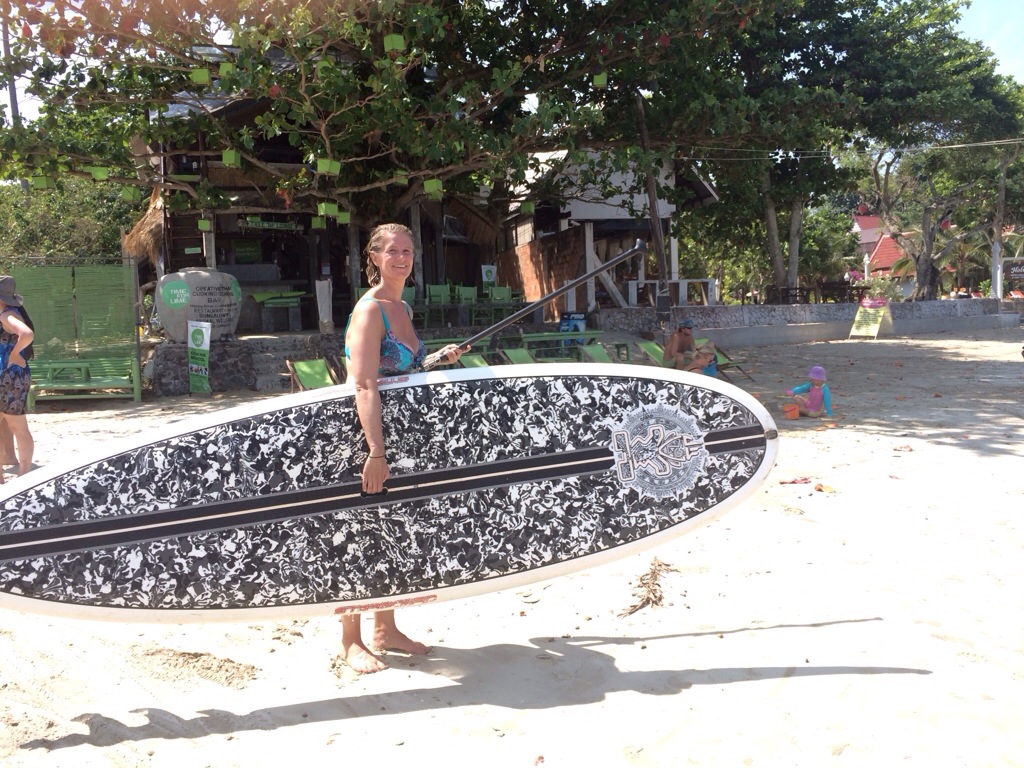
Karin is now a regular at yoga (taught by a very cool Okie transplant), Zumba (taught by a friend and sometimes babysitter for Max), Friskies o Svettis (a Swedish thing – circuit/dance/aerobics) on the beach, and Stand-up paddle board fitness class, which is like an exercise class on a drifting surf board. I’m in for the yoga, paddle board class, and another boot camp on the beach.

I think between this list and our own workouts, we’re probably each averaging one athletic something per day. Which is good, because nobody is skipping any meals!

20140319-160108.jpg

20140319-160127.jpg

20140319-160423.jpg

New Thai dish discovered!

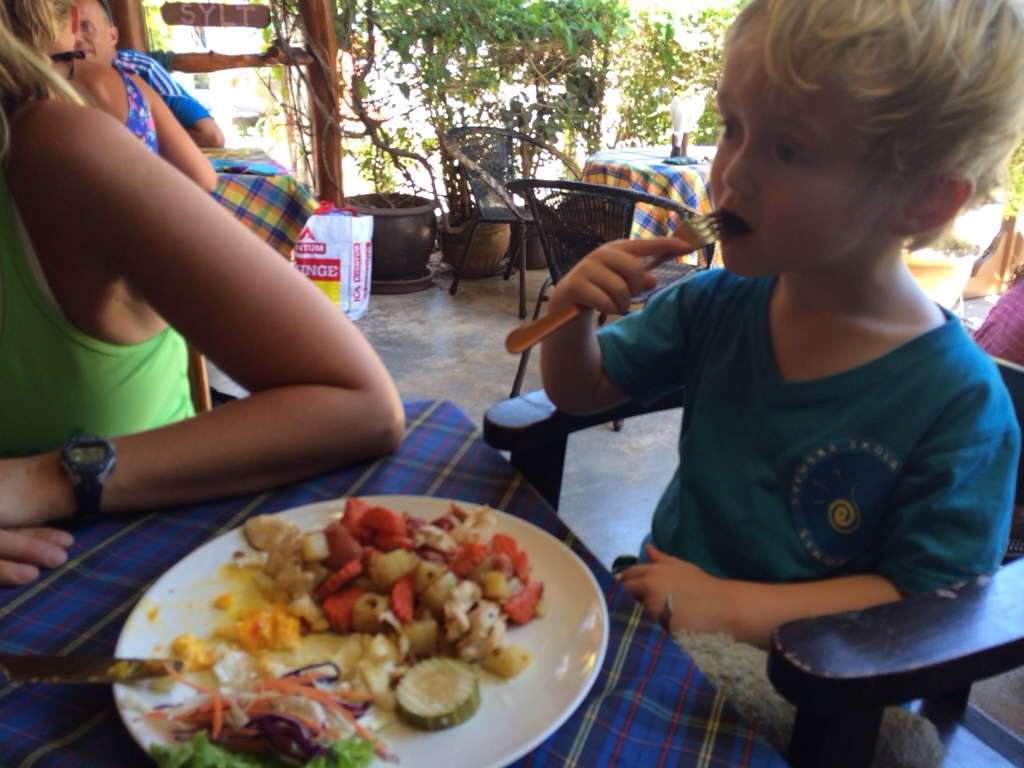
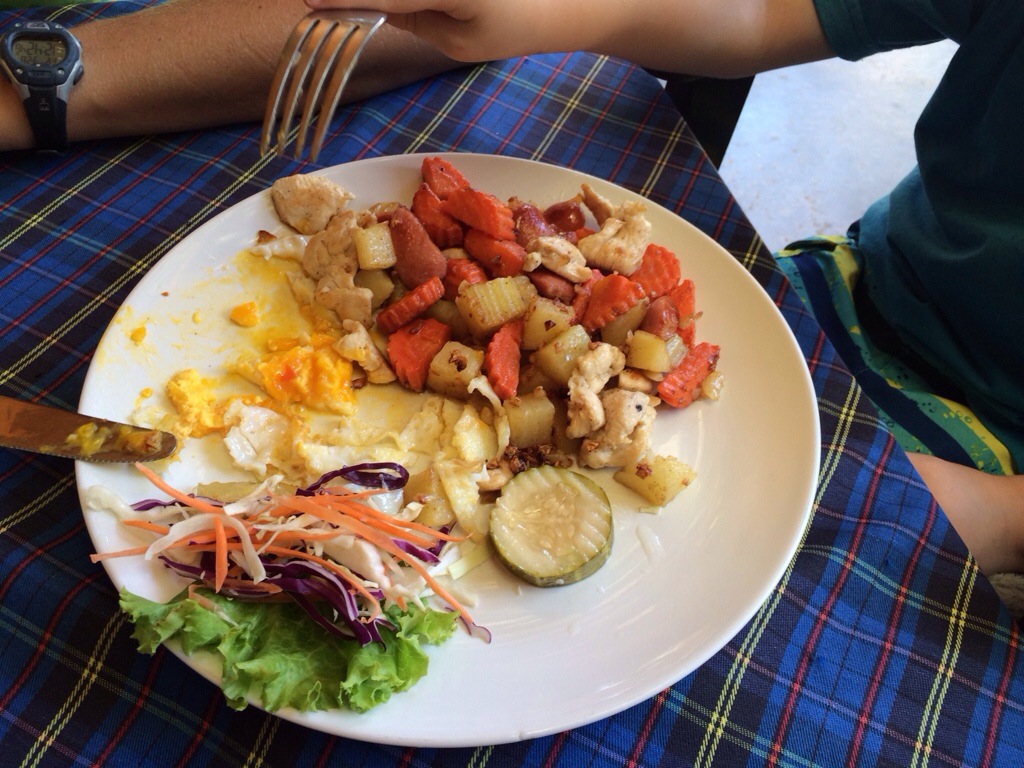
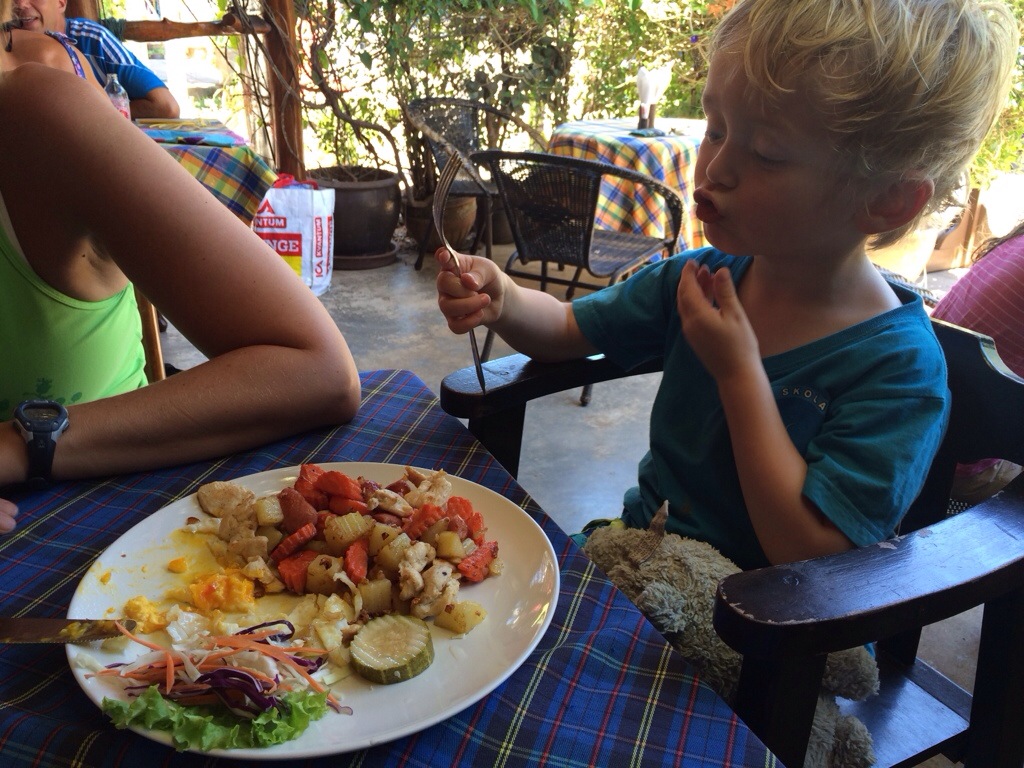
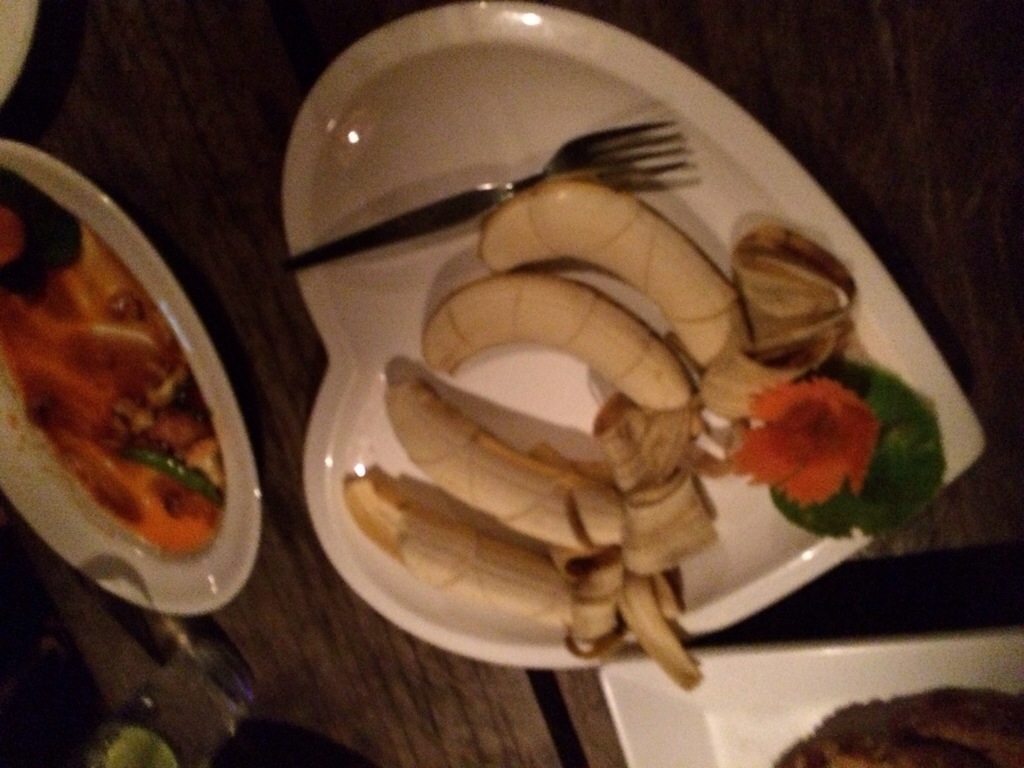
There’s a great dish that is served at Mae’s, a restaurant near our apartment and also served for lunch sometimes at Max’s preschool. It’s called pyttipanna and Max is a big fan.

Here’s the story, for those of you who are unfamiliar with it:

Often described as a hodgepodge of food, a pyttipanna is a classic dish of the Nordic countries of Sweden and Norway consisting of fried potatoes, meat, and caramelized onions. The dish can also be found under various other names. In Denmark, it is known as biksemad, while in Finland it is called pyttipannu. Sometimes the dish may be listed as pytt i panna or pytt y panna or simply abbreviated to pytt.

Ok, it’s not exactly classic Thai, but since it has expanded Max’s list of approved dishes from about 5 to about 6, we’re not arguing.

20140304-174153.jpg

20140304-174140.jpg

20140304-174206.jpg

If you’re not Nordic and you’re thinking, “hey, I’ve seen that dish!” that’s because…

A pyttipanna has similarities to a number of other hearty dishes fried in the pan in other parts of the world. One example is corned beef hash, a dish found in the United States, which is a pan-fried mixture of onions and diced potatoes with corned beef. It has also been compared to bubble and squeak, a traditional English dish made of leftover vegetables such as potatoes and cabbage sauteed together in a pan.

Want to make your own?

Traditionally, a pyttipanna is made from the leftovers of other meals. Therefore, the type of meat added to the dish can vary based on what leftovers are in a household. A leftover pot roast, veal, or Christmas ham could be used, as can steak, pork, and bacon.

To make pyttipanna, the ingredients are generally fried in oil or butter in a skillet. Finely chopped onions are cooked until browned and then removed from the hot skillet and replaced with diced potatoes, which are also cooked until golden. These potatoes may be precooked, but raw potatoes might also be used. After removing the potatoes from the pan, leftover meat is sliced and tossed into the pan until the meat is warmed through. Then the potatoes and onions are stirred back into the meat mixture, and the dish is allowed to continue cooking until browned and crisped.

Instead of making the pyttipanna from leftovers, however, it is also becoming commonplace to make the dish out of fresh premium meats. If making from raw meat, the meat may need to cook first and will likely need to saute for a longer length of time to become tender. In addition to the basic ingredients, mixed herbs, a clove of garlic, or leftover vegetables are also included in some recipe variations.

The pyttipanna is usually served with a raw egg yolk on top. Alternatively, a fried egg may be used to top off the dish. In fact, a second frying pan is usually used as the pyttipanna is in the final moments of cooking to prepare a sunny-side up egg or some other fried variety. Pickled red beets, capers, and sliced pickles are also commonly served on the side.

Max goes for the potatoes, a few carrots, and the fried egg on top. Meats and other unidentifiables need not apply.

Smaklig måltid, bon appetit, and ขอให้เจริญอาหาร! (kŏr hâi jà-rern aa-hăan!)

Thrown out of a Bangkok massage parlor for…

…having ugly feet.

OK, technically it wasn’t in Bangkok.  It was in Saladan, the small town nearest to where we live.  And it wasn’t really a “massage parlour” in the titillating sense.  It was one of the ubiquitous places here where you can get manicures, pedicures, massages, a cup of cleansing tea, etc.

But somehow “Saladan Bamboo Foot Care and Traditional Thai Massage Center” just doesn’t have the same headline cache as “Bangkok massage parlour.”

Anyway, my feet have always been rough and (in Karin’s words) horrible.  Now, after a few weeks of going mostly barefoot or in sandals, running, doing bare-foot boot camp on the beach, etc. my feet are extra crunchy, scratched, and have a couple of small punctures from rocks and coral.  So I went in for a foot scrub.  The manager gave me a warm smile and asked to see my feet.  “Oh.”  She assigned me to, I presume, a very competent staff member who had me lay down, feet up, and then began to apply some coconut oil mixed with something else.  All good.  After a while, she walked away, chatted with the manager, and walked back.  She continued to apply oil while peering closer at the landscape of one foot and then the other.  She seemed to be saying “Tsk, tsk” in Thai.

The manager came over and they started to work together.  Then other staff joined in to have a look, chatting with each other and pointing at different parts of my feet.  It seemed a bit like medical residents doing rounds and stopping to look at a particularly interesting (sad?) case.

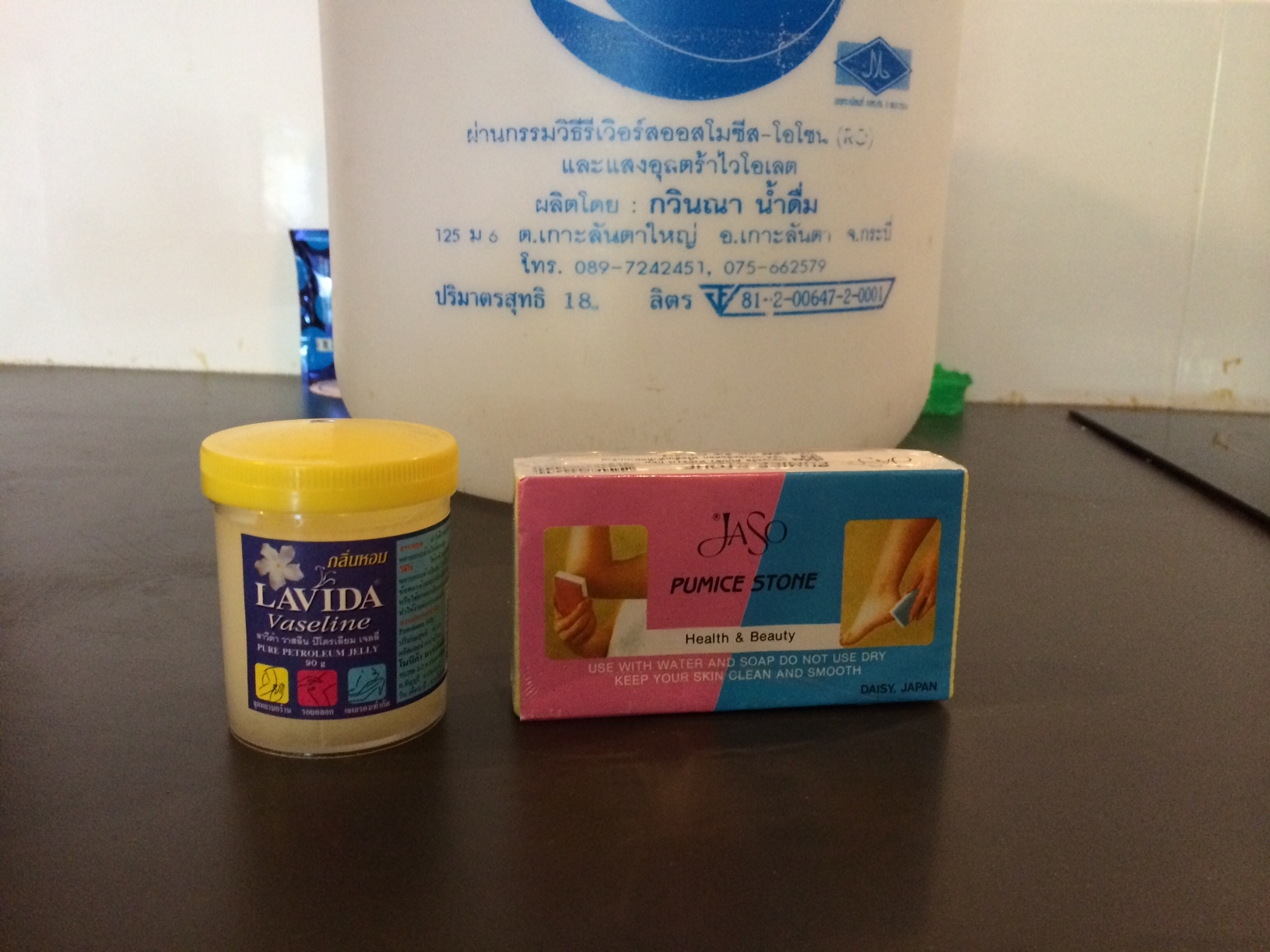
After about 15 minutes of staring, scrubbing, chatting, and pointing, the manager, who I later learned was married to a German and spoke pretty good English, explained that I had some real issues.  Hard skin here, soft there, neglect everywhere.  She finally said apologetically that they “couldn’t really help me”.  She offered some products to take home (a pumice stone and a small tub of vaseline) and gave me very specific directions about how to scrub and vaseline my feet every day.  She repeated the instructions about 3 times to make sure I didn’t screw it up.  She said that she wouldn’t charge me for any of this (except about $1.50 for the products) and invited me back in a few weeks after I’ve completed the triage.  I was offered a cup of tea and shown the door.

So now I’m off to bed, with self-scrubbed feet that are coated in vaseline and cozy in clean socks.

Image

Remedial foot care products.

A new apartment, relativity, and stuff.

For the week since we got to Koh Lanta, Karin has been working the local Swedish rental mafia to create some housing options for us.  It’s actually quite busy here until the end of March so my attitude when we were in Victoria of “relax, I’m sure we’ll find good places once we get there” wasn’t leading to ulcers, but it also wasn’t leading to leases.  So thanks to the internet and some hustle (relative to the pace of this place, which is slow), we ended up choosing between a couple of apartments, both connected to the bungalows / hotel where we were staying already. 

So on Thursday, we moved into a furnished apartment.  It has an open livingroom and kitchen in the main room and then a large bedroom with room for our bed, another bed, Max’s bed around the corner, closets, and an en suite bathroom.  Both rooms have balconies and big windows that look out into 2nd floor greenery. 

I think total apartment is about 50 sq meters / 500 square feet.  (I’ll attach photos later.)  

Now the relativity bit.  If we had moved here directly from our place in Victoria which was signficantly larger and had way more “stuff”, I believe we would have said something like “This place is fine.  I’m sure it’ll be fine for our stay.”

But after just 2 weeks of staying in smaller hotel rooms and one-room bungalows, This 2-room home is a PALACE.  All 3 of us are a bit giddy at having more space.  Max now has his “library” and “toy garage” organized.   We’ve got a gourmet kitchen (fridge big enough to hold yoghurt and fruit, 2 stove elements, a sink that isn’t right next to the toilet).  Clothes can actually be unpacked.

Anyway, there’s a lesson in here, especially coming fresh on the heels of a massive, weeks-long purging exercise in Victoria during which we sold a house and 2 cars and then gave, sold, threw out, donated, recycled, and eventually stored massive quantities of stuff.  It shocked us just how much STUFF we had accumulated.  3 people don’t need that much plastic, metal, wood, cotton, and whatever else.  It’s just silly.  Oh, there are always excuses.  “We combined 2 households” (that was years ago and it still doesn’t explain the things we had 3 or 4 of) and “You need it when you have a kid”  (No, the kid didn’t buy any of it and doesn’t use 98% of it.)  Thank goodness for the friends and family who took, used, and/or helped to place a lot of it.  If you need anything else, just let me know and we’ll give you the key to the storage locker.

Whatever self-image I might have had as someone who was travelling light in this world, those delusions were put to rest by the physical evidence and vivid images of multiple car-loads of stuff driving away followed by a moving truck full of stuff heading to storage.

I mentioned to a friend that I wasn’t quite ready to become a Buddhist monk and renounce all material things, but this chapter and this perspective (which is likely going to fade again eventually) definitely invites some reflection on choices and the accumulation of STUFF.